

Technology
Buying AI for your company? Here's what that really means in logistics
A plain guide to what "buying AI" actually means in logistics — from back office automation to agentic logistics and physical AI — and how to tell value creation from another dashboard.
Tatu Rouhiainen
•
Buying AI for Your Company? Here's What That Really Means in Logistics
If you've been told to "implement AI" this year, you're not alone, and the instinct is a good one. For most enterprises, the pressure is real and it comes from the top — boards, investors, and executives who want to see the company innovating and keeping pace with the world. The mandate arrives before the roadmap does. So the honest first step isn't buying anything; it's understanding what AI actually does in an operation like logistics, so the budget you've been handed goes toward value creation rather than a tool that looks impressive in a demo and changes nothing on the ground.
This is a plain-language guide to that — no jargon required.
What "AI for logistics" actually means
Strip away the buzzword and what most companies actually need is straightforward: fewer people tied up in manual work, faster decisions, better visibility, and lower cost over time. Those are the real goals underneath the mandate. AI is one way to get there — but only certain kinds of AI, applied in certain places, actually move those numbers.
Logistics is a revealing place to start, because it sits on a genuine paradox. A modern delivery operation generates more raw data per asset than almost any other sector — every vehicle is a rolling sensor producing location, routing, fuel, idling, and emissions data constantly. Yet the industry faces some of the steepest operational hurdles to actually using that data, because so much of the work still runs on paper packing lists, printed receipts, and manual logs. The data exists; turning it into decisions is the hard part. That gap is precisely where AI earns its budget — and it's why companies like Way have built entire businesses on unlocking native vehicle data that operators were already generating but couldn't use.
The distinction that matters most: AI that runs an operation vs. AI that reports on it
Here's the single most useful thing to understand before you spend a euro.
There are two very different kinds of "AI" being sold right now, and they're easy to confuse because they use the same language. The first reports on your operation — it takes data and turns it into dashboards, summaries, and charts. The second runs your operation — it makes or informs the actual decisions: which vehicle goes where, how a route reorganizes when volume spikes, when capacity gets reallocated.
The difference matters because reporting AI is now available to everyone. The tools to generate a nice analytics dashboard are cheap, plentiful, and increasingly commoditized — which is exactly why a large wave of reporting-only software is quietly dying as the underlying capability becomes something any company can add in an afternoon. If the only thing a provider's AI does is describe what already happened, you're buying something that's rapidly becoming free.
The durable value is in the other kind: AI applied to the physical world — to the movement of real goods, real vehicles, and real decisions with real consequences. That's far harder to build, far harder to copy, and it's where the genuine advantage lives.
The vocabulary, decoded
A few terms are worth knowing so you can follow the conversation and ask the right questions:
Automation is the foundation: taking a task that used to be done by hand and having software do it reliably. In logistics this starts with the unglamorous but high-value back office — back office automation like invoicing, which used to eat hours of manual work and now runs on its own.
Supply chain automation extends that idea across the operation — the coordination, dispatch, and reporting tasks that used to require someone actively managing them start to run without constant human intervention.
Agentic logistics is the newest term, and it means AI that doesn't just recommend — it acts. Rather than flagging a problem for a human to solve, an agentic system can take a defined action on its own within set boundaries: reorganizing a route, reallocating a vehicle, responding to a change in real time. The word "agentic" simply means the software has agency to do, not just to suggest.
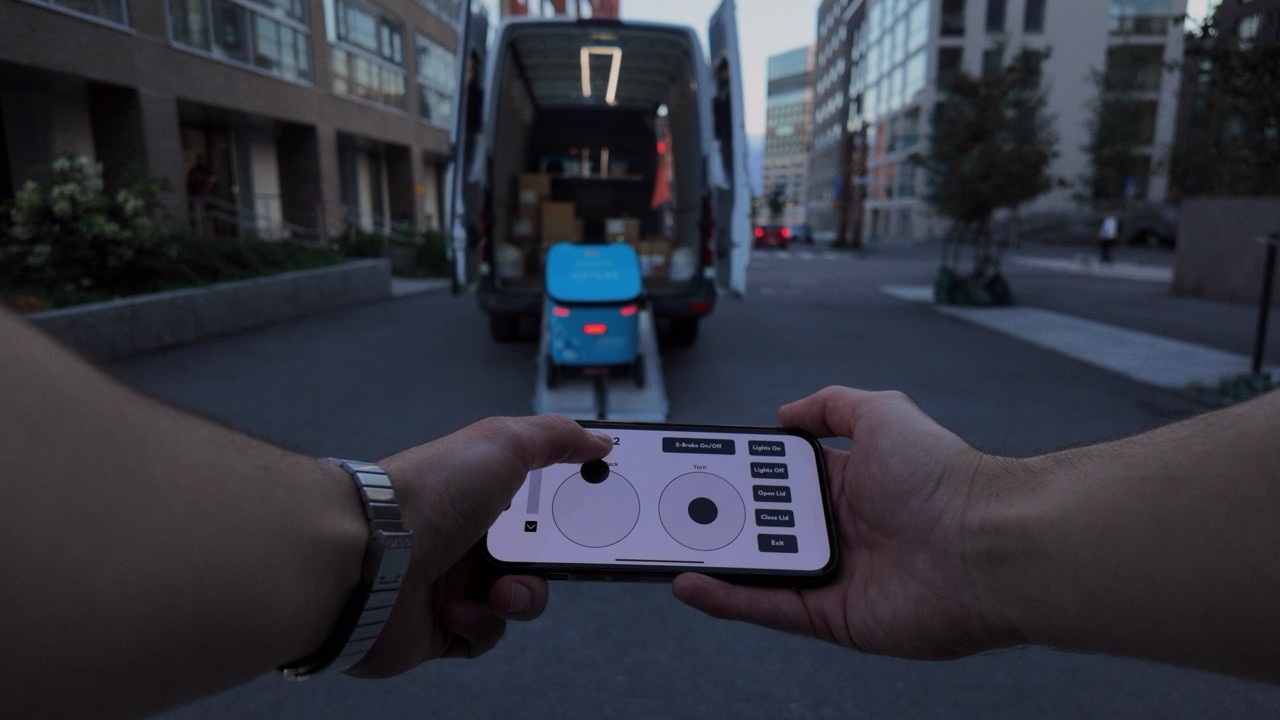
Physical AI is the anchor that ties all of this to reality — AI that operates in and acts on the physical world rather than living purely on a screen. In logistics this is the whole game, because at the end of every optimization, a real van still has to show up at a real door. Physical AI is what connects the intelligence to the vehicle.
Where AI genuinely can't help yet
A guide you can trust has to be clear about the limits, and in logistics they're significant.
AI cannot move physical goods. That much is obvious, but the consequence is under-appreciated: roughly 40% of working time in city logistics happens outside the vehicle — the handling, the building access, the last few metres to the door, the human coordination at each stop. That work is nowhere near automatable today and won't be for a long time. Realistically, driving itself will be automated before the messy physical work around each delivery is. So any pitch that implies AI will run your city delivery operation end-to-end, today, is overselling. The honest picture is AI removing the manual and repetitive work around the edges and sharpening the decisions in the middle, while people and vehicles still do the physical job.
What to be skeptical of
When a provider says "we use AI," ask one question: does it make decisions or move goods, or does it just show me a dashboard?
Plenty of companies will claim AI because the label sells. The risk is that what's underneath is another reporting layer — part of that same wave of commoditized software that's losing its reason to exist. The providers worth your budget are the ones where AI is wired into the operation itself: informing dispatch, reorganizing routes, generating verified data as a byproduct of the work rather than as a report assembled afterward. If you can't get a clear answer about what the AI actually does to the movement of goods, treat that as the answer.
This is the same test we've written about before in a non-technical context — whether a provider's technology is a genuine operating system that decisions get made in, or a dashboard bolted on for show. For the full version of that question, see our buyer's checklist for choosing a city logistics partner and our breakdown of 3PLs, carriers, and Neocarriers.
The bottom line
"Buying AI" isn't really the goal — the goal is the outcome you were handed a budget to achieve: less manual work, faster decisions, better visibility, lower cost. AI delivers those when it's applied to the real operation, not painted on top of it. Start by asking what the AI actually does to the movement of goods and the decisions behind it. That single question separates the tools that will still matter in three years from the ones already on their way out.
